DACHNUG 2026 took place this year from 9 to 11 June at NOVUM in Würzburg. As a conference – organised by the German Notes User Group (DNUG) – for users and providers of HCL‘s software solutions (in the fields of enterprise collaboration and no-code/low-code/pro-code application development), it was once again the ideal venue for us to be present with the CEIR-Team and our University Competence Center for Collaboration Technologies (UCT).
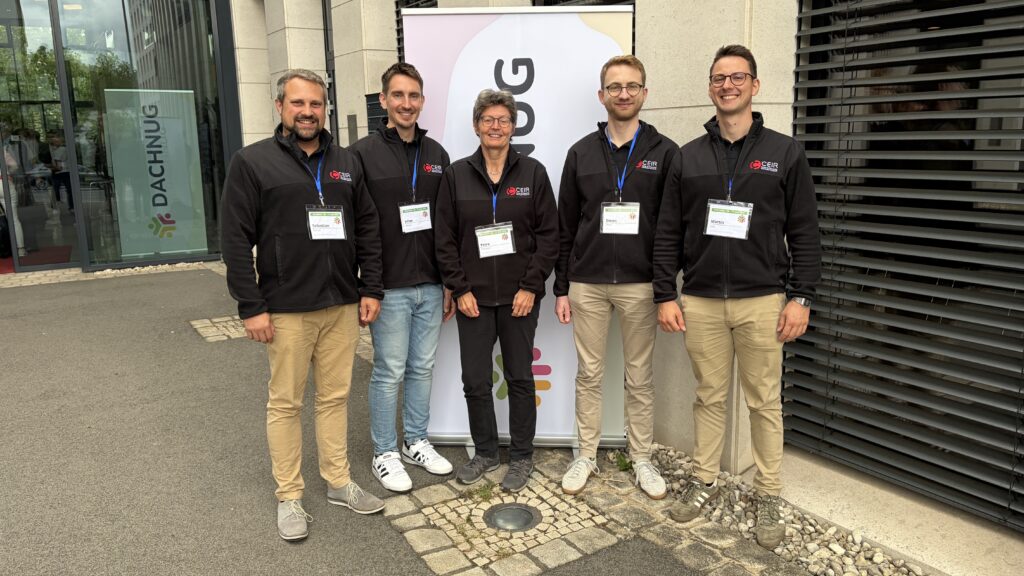
Even without our own exhibition stand, we used this year’s conference to present our current research and development projects in two specialist talks and to engage in direct dialogue with the community of users, developers and HCL representatives.
The first day of the conference began, as is traditional, with half-day workshops, followed by a get-together in the evening. On the second day of the conference, the programme was officially opened following the opening remarks and the HCL keynote speech. The theme of the keynote speech, ‘Data sovereignty – opportunities in a new era of IT’, served as a common thread running through many of the day’s sessions.
Our first presentation also tied in with the theme of the keynote speech.
Presentation 1: NextGen Enterprise Collaboration – Digital Sovereignty Check-up
Sebastian Bahles and Petra Schubert opened the CEIR team’s session on Wednesday afternoon with a presentation entitled “NextGen Enterprise Collaboration Technology – Check-up: Is my collaboration portfolio future-proof and digitally sovereign?”.
The presentation examined how companies can strategically position their collaboration portfolio and systematically assess it for digital sovereignty. The starting point was an overview of the Enterprise Collaboration Platform (ECP) and its various layers – from communication and office tools, through groupware, to enterprise applications. Each of these layers has its own ‘sovereignty stack’ comprising hardware location, operating model, code and data openness, and licence type.
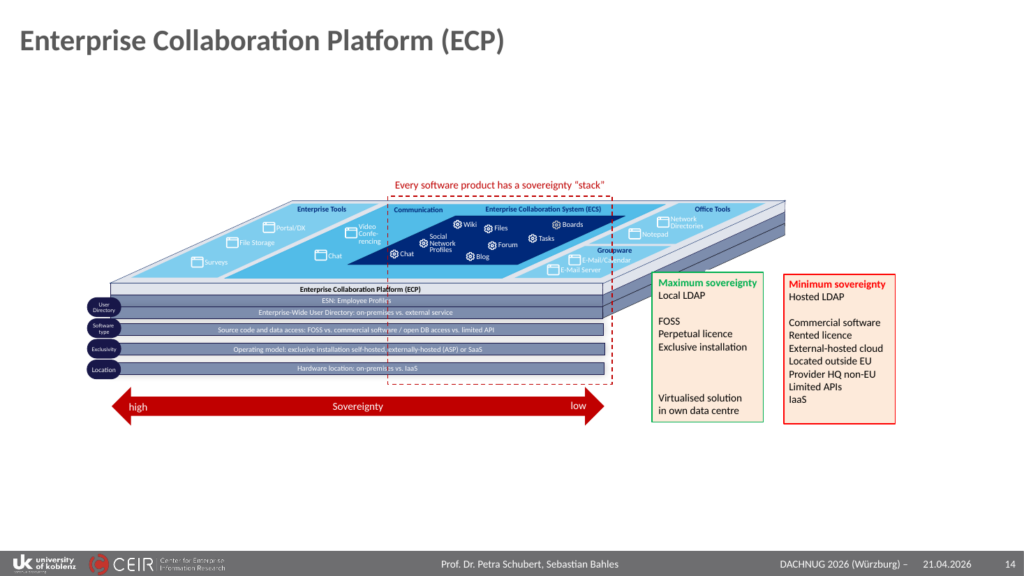
Following a review of a wide range of terms and frameworks relating to digital sovereignty, the session concluded with an interactive live poll involving the conference participants, during which the audience assessed selected collaboration tools directly against a framework presented during the talk. The results sparked a lively discussion: how much sovereignty does a company need, depending on the use case – and which of the six dimensions is the most critical in an emergency? It became clear that the right level of sovereignty always involves striking a balance between the company’s individual circumstances – business continuity, existing IT capacities and the available budget.
Presentation 2: Understanding digital workspaces – structure, activity and knowledge
Immediately afterwards, Simon Meier, Martin Just and Julian Mosen presented their research under the title “Understanding digital workspaces: structure, activity and knowledge in your workspace”.
To this end, the team presented three complementary tools, each of which offers a distinct perspective on the same workspace:
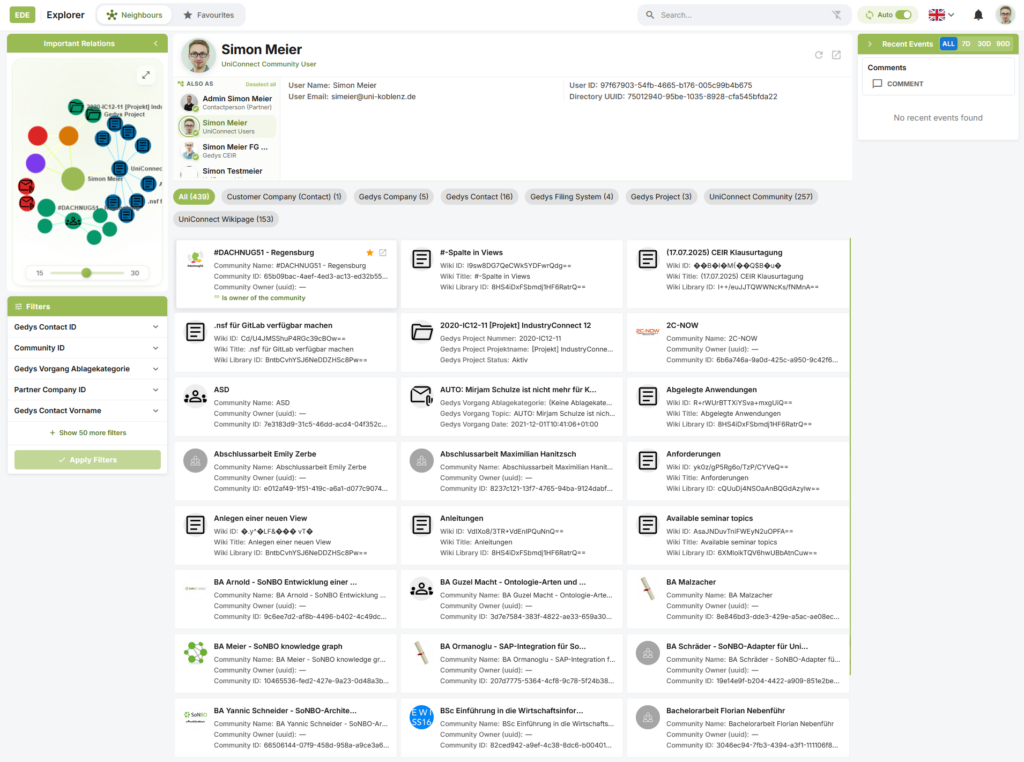
Enterprise Data Explorer (EDE) – Structure
The EDE visualises the structure of a workspace. Using an Enterprise Knowledge Graph, staff can explore which projects, people and workspaces exist and how they are connected, without having to search through each system manually. Click by click, you can navigate from a person to their workshops, and from there to the participating organisations or to associated social business objects.
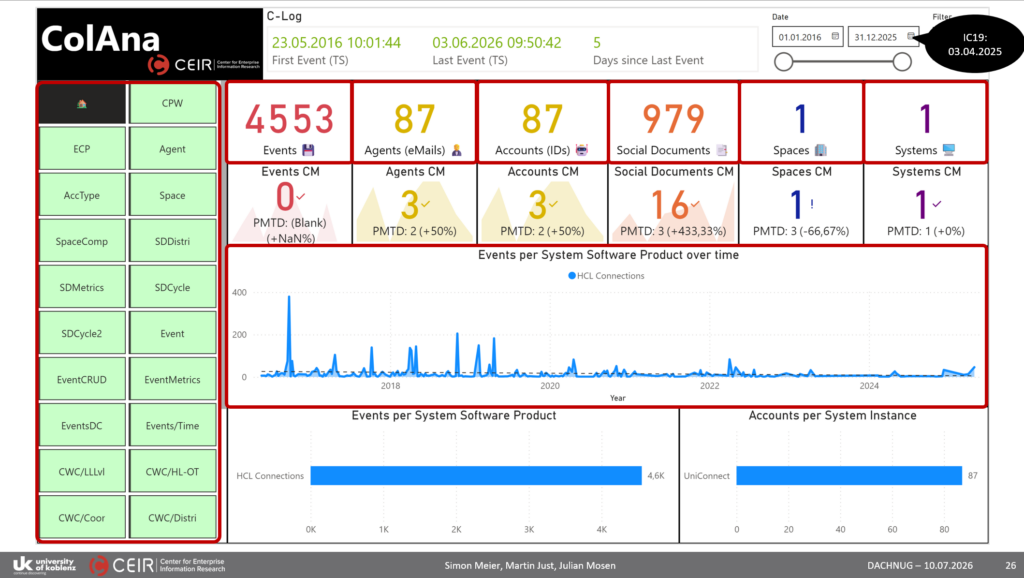
ColAna Dashboard – Activity
The ColAna Dashboard analyses activity within a workspace based on log data. It shows who is collaborating with whom, when and to what extent a community or workspace has been active, and classifies contributions using Collaborative Work Codes (CWC). Interactive network graphs, time-series analyses and word clouds reveal patterns of collaboration that would otherwise be lost in the noise of day-to-day activities.
Workspace Assistant – Knowledge
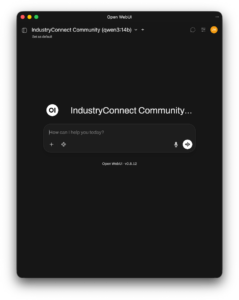
The Workspace Assistant harnesses the knowledge contained within a workspace’s content using Retrieval Augmented Generation (RAG). Users can ask questions in natural language and receive direct, source-based answers without having to find the right search terms or use the appropriate language. The answers are anchored in the actual workspace content and include hyperlinks to the source, which rules out hallucinations. The system is based entirely on open-source components (n8n, Qdrant, Ollama, Open WebUI) and can be run locally; this represents an important contribution to digital sovereignty, building on the theme of the previous day’s presentation.
The three tools complement one another to form a comprehensive solution: EDE for an exploratory view of structure, ColAna for the analytical evaluation of collaboration, and the Workspace Assistant for conversational access to knowledge: scalable from individual projects to the entire organisation, technology-agnostic and fully operable on-premises.
Alongside our own presentations, there was time for discussions with participants, partners and HCL representatives. The evening programme on the second day of the conference – featuring a guided tour of Würzburg and a fantastic view over the city during dinner at the Nikolaushof, also created memories that will linger.
The third day of the conference concluded with the traditional ‘Ask HCL’ session and a brief closing address. The combination of a modern conference venue in the heart of Würzburg, a varied programme with a clear focus on digital sovereignty and AI, and a dedicated community of users, developers and providers ensured that the 2026 event was once again characterised by insightful discussions and was an all-round success.